Benchtop Water Filters — What They Are and Where They Work
Benchtop water filters come in three main configurations. The first and most common is the gravity-fed benchtop unit — a large stainless steel or plastic cylinder that sits on the counter, into which you pour tap water. Gravity pulls the water through a filter cartridge into a lower reservoir. These units require no plumbing connection whatsoever, making them attractive to renters or anyone who wants a completely tool-free setup. The trade-off is speed: gravity filtration can take 30–60 seconds per litre, meaning you fill a jug and wait rather than drawing filtered water on demand.
The second type is the direct-connect benchtop unit, which attaches to the kitchen tap via a diverter valve. When you want filtered water, you switch the diverter to redirect flow through the filter unit. Flow rates are faster than gravity models, but you are still left with a unit occupying counter space and the diverter attached to your tap. In Sydney's compact apartment and terrace kitchens — where bench space is genuinely limited — this is a real practical issue.
The third is the countertop reverse osmosis unit, which delivers better filtration performance than the above two types and approaches under-sink RO in contaminant removal. However, these units are bulkier, more expensive (often $600–$1,200 for the unit alone, without installation), and still occupy a permanent chunk of bench space. At that price point, a professionally installed under-sink RO system often becomes the more sensible option.
Benchtop filters have genuine strengths. They require no installation, no landlord permission, no plumber, and no tap hole. They are portable — ideal for share houses, students, travellers, or people in very short-term accommodation. Upfront cost is low. However, the limitations are real: ongoing proprietary cartridge costs, slower flow rates, significant counter space usage, plastic components, and materially lower filtration performance compared to a professional under-sink system in the same price bracket.
For a renter who has tried to get landlord permission and been refused, or for someone in a temporary living situation, benchtop is a legitimate solution. Jean-Paul acknowledges this honestly. But for the majority of Sydney homeowners and long-term renters, benchtop is a short-term compromise rather than a permanent solution.
Under Sink Water Filters — Why They're the Professional Standard
Under-sink water filtration is the format used in virtually every professional and commercial setting — restaurants, cafes, dental clinics, medical practices — and for good reason. The under-sink format allows a full-sized filter housing, professional-grade media, and connection to the cold water supply line at a point before your drinking water tap. The water is filtered on demand, at near-full mains pressure, with no reservoir to fill and no bench space used.
The filtration performance difference is significant. The Pure Essential ($550) uses full-size carbon block cartridges — the same format and media used in commercial water treatment. It removes chlorine, chloramines, sediment, taste and odour at a level that no $100–$200 benchtop gravity filter can match. The Pure Plus+ reverse osmosis system ($840) adds a commercial-grade RO membrane that filters down to 0.0001 microns — removing fluoride, nitrates, heavy metals, PFAS, dissolved solids, and microplastics. The water in the small storage tank under your sink is genuinely as clean as high-quality bottled water, delivered on demand from your own tap.
Flow rate is another practical advantage. Under-sink systems deliver water at near-full mains pressure through a dedicated filtered tap. You fill a kettle, a glass, or a pot of pasta water instantly. There is no waiting, no reservoir management, no fill-and-forget cycle.
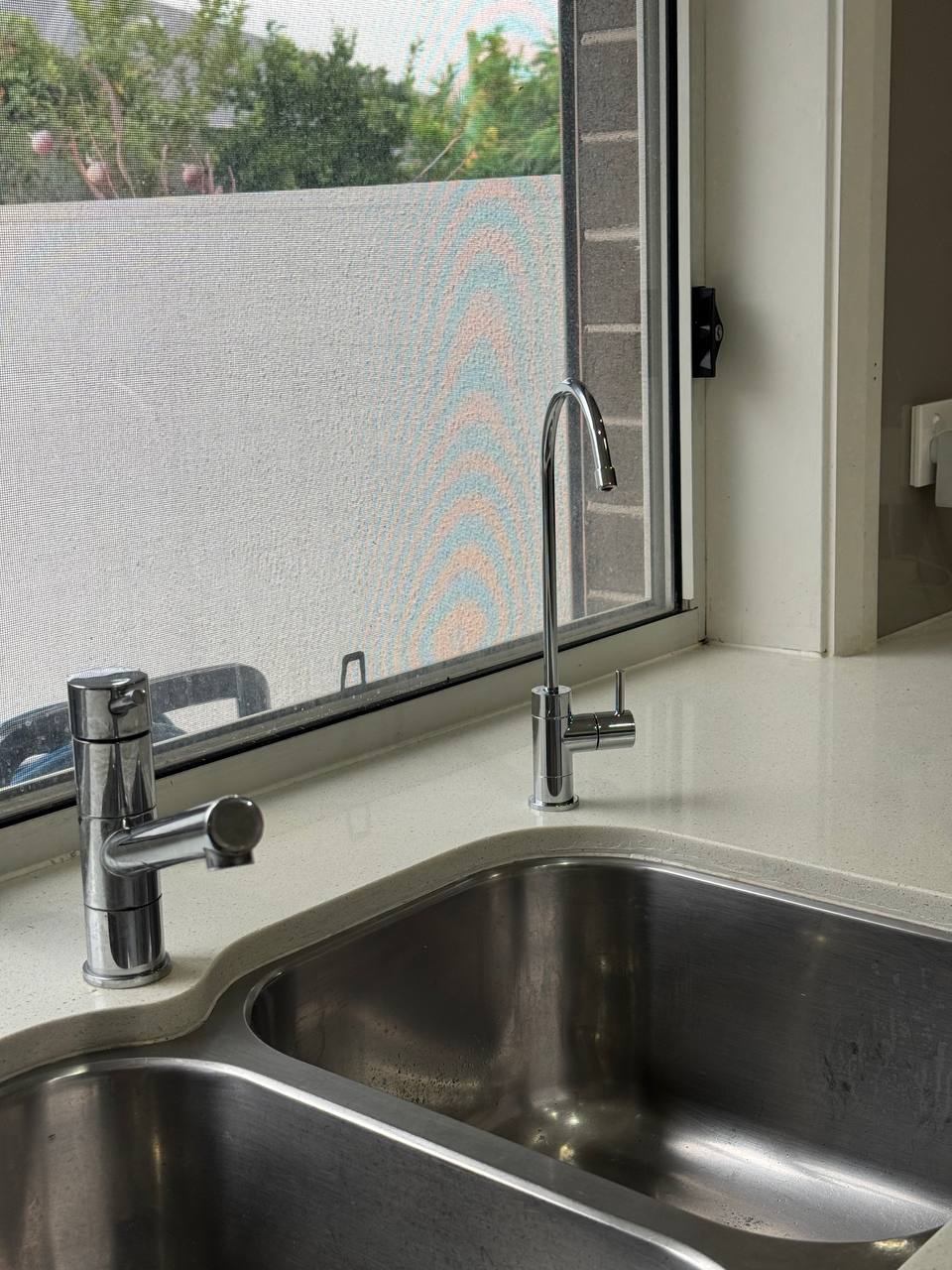
From an aesthetics and kitchen-cleanliness standpoint, an under-sink system is invisible. The only sign of it is a second tap at the sink deck — the dedicated filtered water tap. No equipment on the bench, no hoses, no unit to clean around. In Sydney homes where kitchen aesthetics matter, this is a meaningful practical benefit.
Cartridge maintenance is straightforward. Under-sink filter cartridges are replaced once every 6–12 months depending on usage — a task Jean-Paul can handle on an annual service visit, or that most homeowners can do themselves in under 10 minutes. Annual cartridge cost for the Pure Essential runs $80–$120. For a full RO set at the Pure Plus+ level, expect $160–$280 per year depending on water usage. This is comparable to benchtop running costs and does not involve the messier process of cleaning gravity-filter reservoirs.
The total cost of the Pure Essential — $550 — covers the system, the installation labour, the dedicated filtered tap, all fittings and connections, a full system walkthrough from Jean-Paul, and a lifetime workmanship warranty on the installation. There are no additional charges on the day and no hidden fees.
The Direct Comparison — Under Sink vs Benchtop
The table below summarises the key differences between under-sink and benchtop water filter options for Sydney homes. Under-sink entries reflect Filters For You's professionally installed systems.
| Feature | Under Sink Recommended | Benchtop |
|---|---|---|
| Installation required | Yes — licensed plumber (included in price) | No — plug and go |
| Bench space used | None — fully hidden under sink | Permanent counter footprint |
| Flow rate | Full mains pressure — instant | Slow (gravity) or moderate (direct-connect) |
| Filtration performance | Professional-grade carbon or RO | Consumer-grade — variable |
| RO contaminant removal | Up to 99% (Pure Plus+ and above) | Lower — most benchtop units do not offer true RO |
| Annual cartridge cost | $80–$280 depending on system | $80–$200 (often proprietary, harder to source) |
| Portability | No — permanent installation | Yes — fully portable |
| Kitchen aesthetics | Clean and invisible — second tap only | Visible unit on bench |
| Renter-suitable | Yes — with landlord permission for tap hole | Yes — no permission required |
| Fixed price (supply + install) | From $550 | From $80–$400 (unit only — no installation) |
Looking across these rows, the picture is clear for permanent homes. Under-sink wins on performance, flow rate, aesthetics, and the absence of any counter space impact. The only rows where benchtop holds an advantage are portability and the absence of an installation requirement — which matters primarily for renters who cannot obtain landlord permission and for people in genuinely temporary accommodation.
On price, the comparison is less one-sided than it first appears. A benchtop unit purchased for $200 and running $120 per year in proprietary cartridges costs approximately $440 over two years. The Pure Essential at $550 all-in, with a $90 annual cartridge cost, costs approximately $640 over two years — and that $200 difference buys you better filtration, a professional installation, no counter space impact, and a lifetime workmanship warranty. Over three to five years, under-sink becomes the better value proposition in virtually every scenario.
Honest Recommendation — Which Should You Choose?
Jean-Paul recommends under-sink for any Sydney homeowner, and for renters who can obtain landlord permission for a tap hole in the sink deck. That permission is a small hole — typically 35mm — that most Sydney landlords approve without hesitation once they understand it does not affect the structural integrity of the sink or bench. Jean-Paul can advise on how to frame the request if you are unsure.
Under-sink is also the right choice for anyone who cares about kitchen aesthetics, anyone with genuinely limited bench space (which describes most Sydney apartment and terrace kitchens), and anyone who wants RO-level filtration — because affordable countertop RO units that actually work are difficult to find, whereas under-sink RO from $840 is a known, proven, professionally installed solution.
Benchtop is a reasonable choice for very short-term renters who cannot get landlord permission, students in share houses where a fixed installation is impractical, and people in temporary living situations. If that describes your situation and you call Jean-Paul on 0430 546 749, he will tell you so honestly. He does not sell benchtop systems — but he will not try to push you into an under-sink installation that does not suit your circumstances.
For everyone else — the long-term renter, the homeowner, the family focused on water quality — under-sink is the professional standard for a reason. Jean-Paul can typically schedule most Sydney installations within a week of first contact.