Growing Demand for Apartment Water Filtration in Sydney
Sydney's apartment market has grown dramatically over the past decade. Inner West suburbs — Newtown, Marrickville, Leichhardt, Annandale, Glebe — are now home to tens of thousands of apartment residents. The Eastern Suburbs from Bondi to Randwick, the CBD fringe from Pyrmont to Waterloo, and the North Shore from Crows Nest to Neutral Bay all have dense apartment populations whose residents increasingly expect the same quality of life in their home that house dwellers expect — including clean filtered water.
The good news for apartment residents is that the most effective water filtration systems — under-sink carbon filters and reverse osmosis systems — are specifically designed for indoor kitchen installation. They do not require access to the building's main water supply, they do not alter the external appearance of your apartment, and in the vast majority of Sydney strata-managed buildings, they do not require formal strata approval.
The Apartment Challenge: Strata, Space and Access
The three concerns apartment residents most commonly raise when enquiring about water filtration are: Do I need strata approval? Will it fit in my kitchen cabinet? And can a plumber actually get in and do the work in an apartment building? Jean-Paul has addressed all three concerns hundreds of times in Sydney apartments, and the answer in the vast majority of cases is: no, yes, and yes.
Strata and NSW Law on Minor Modifications
Under the NSW Strata Schemes Management Act, owners are entitled to carry out minor cosmetic work and minor renovations within their lot without requiring approval from the owners corporation in most circumstances. An under-sink water filter installation qualifies as a minor modification in the eyes of most strata managers and legal precedent — it is performed entirely within the kitchen cabinet, does not affect the structural integrity of the building, does not affect common property, and produces no external change to the appearance of the apartment.
Jean-Paul's advice: for owner-occupiers, an under-sink filter almost never requires strata approval. For tenants, check your lease and notify your landlord as a courtesy — a landlord's written consent is generally sufficient. If your strata scheme has unusually specific by-laws, Jean-Paul can help you understand what documentation, if any, is appropriate to provide before booking. In his experience installing across dozens of Sydney apartment buildings, he has not had a strata-related installation blocked.
Space Considerations in Apartment Kitchens
Sydney apartment kitchens vary enormously in configuration — from generous open-plan kitchen islands in newer buildings to compact galley kitchens in older walk-up flats. Jean-Paul is experienced with every configuration he is likely to encounter.
For compact under-sink spaces, the Pure Essential twin-stage filter housing is slim and unobtrusive. For apartments with standard under-sink cabinet size, the Pure Plus+ 5-stage RO system and its pressurised storage tank fit comfortably without modification. For apartments with very limited cabinet space, the Pure Compact 3-stage alkaline RO has a smaller footprint than a standard 5-stage system and is specifically recommended for tight configurations.
Jean-Paul always confirms the fit before any drilling is required. He brings all adapters and connection fittings on every job and measures the available space on arrival. If a system is not going to fit comfortably, he tells you before work begins and recommends an alternative. There are no surprises and no wasted installations.
How Under-Sink Installation Works in a Sydney Apartment
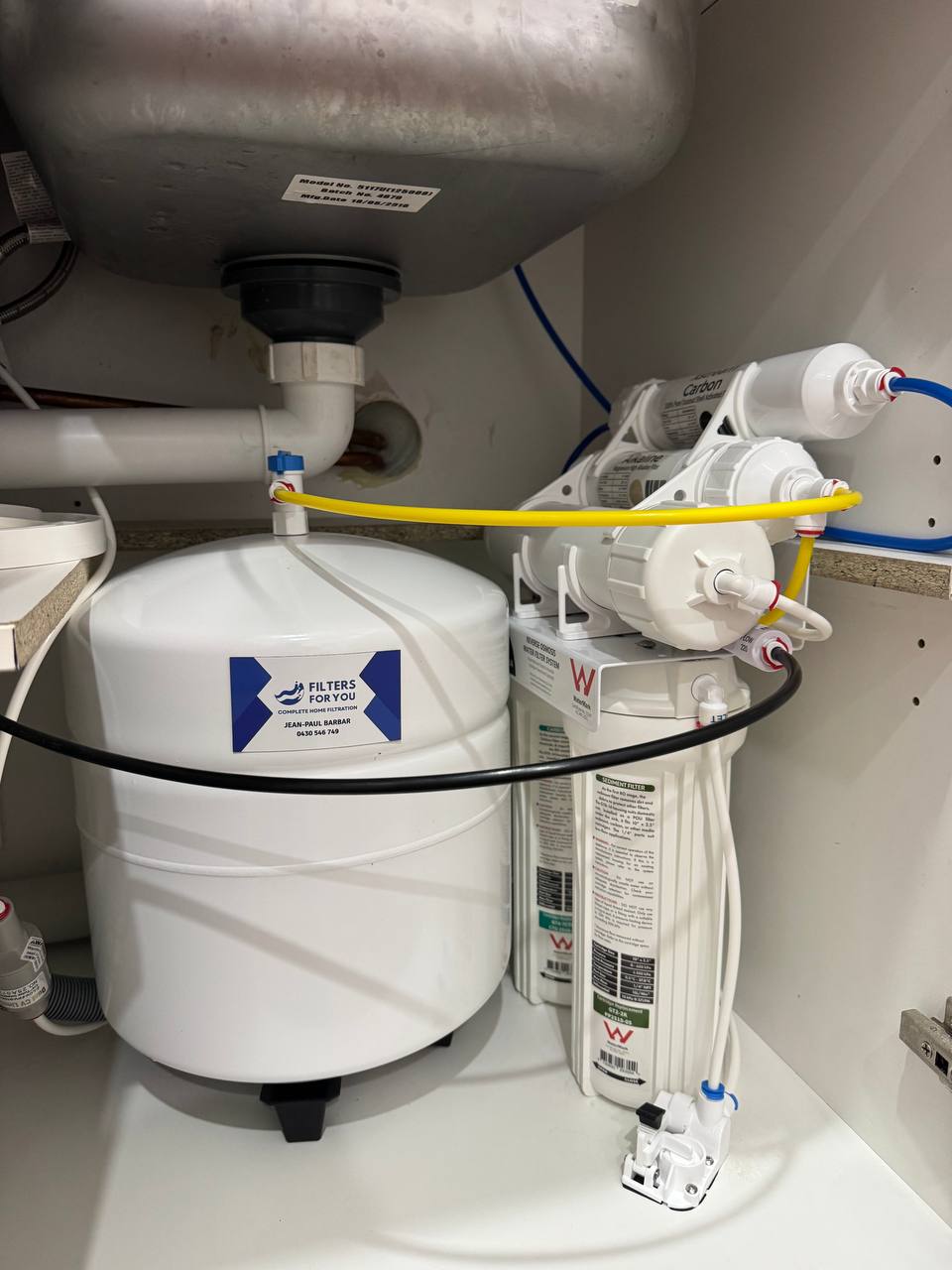
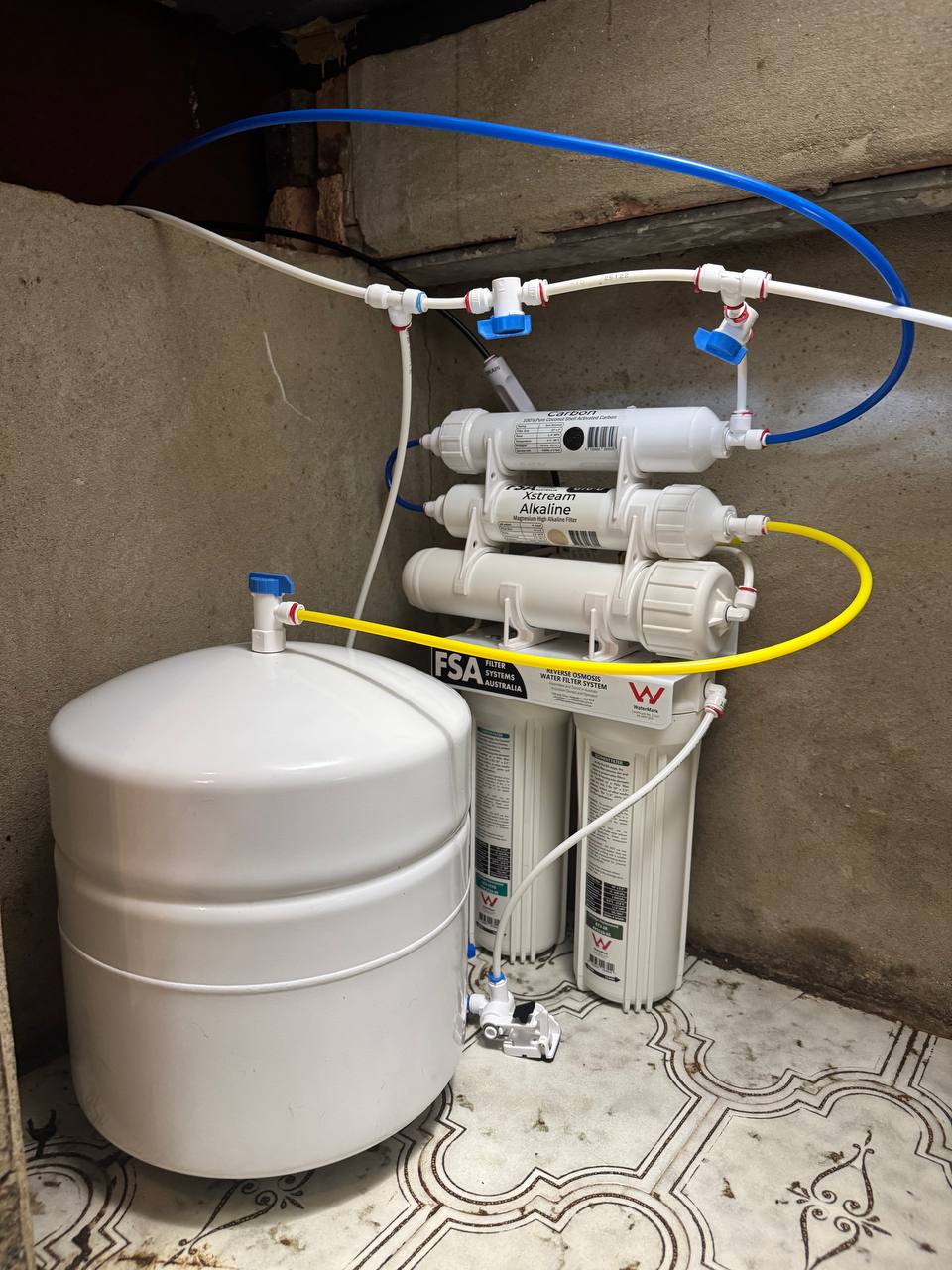
An under-sink water filter or reverse osmosis installation in a Sydney apartment follows the same basic process as in a house — with the advantage that everything is self-contained within the kitchen cabinet. Jean-Paul connects the filter system to the cold water supply line under the sink, installs a three-way tap or T-piece fitting, runs the filtered water line to a dedicated tap on the bench, and routes the waste drain line to the sink drain connection inside the cabinet.
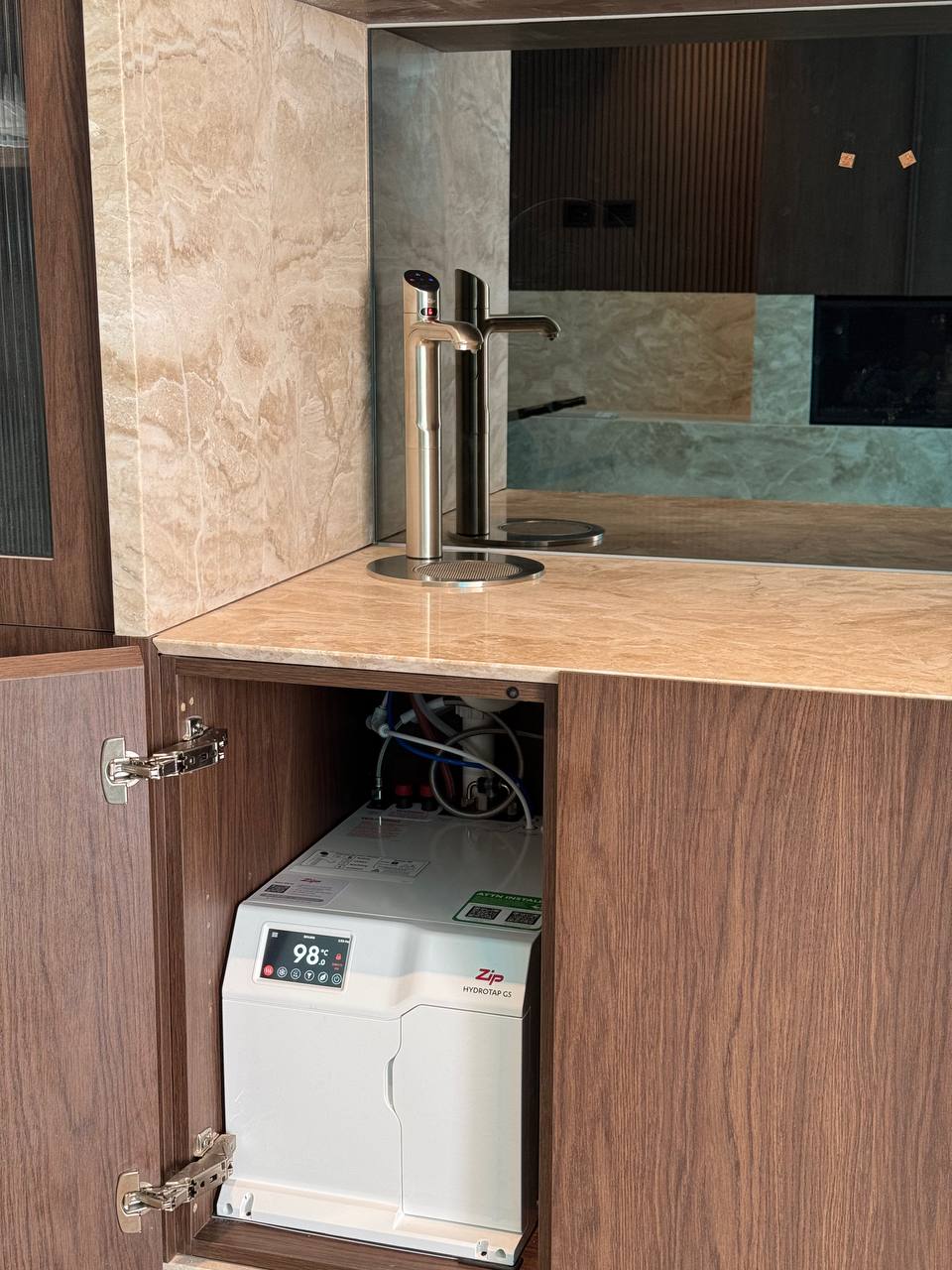
The only visible changes to your apartment after installation are the filtered water tap on your bench and the fact that the inside of your cabinet now houses the filter system. Jean-Paul works neatly, protects surfaces before he starts, and leaves the cabinet interior tidy with all lines properly managed. When he is done, the job looks like it was always part of the original fit-out.
For RO systems, the pressurised storage tank sits at the back of the cabinet. In standard Sydney apartment kitchen cabinets (typically 450–500mm deep), the RO tank fits without difficulty alongside the filter housing. Jean-Paul confirms this on every apartment job before proceeding.
High-Rise vs Lower-Level Apartments: Any Differences?
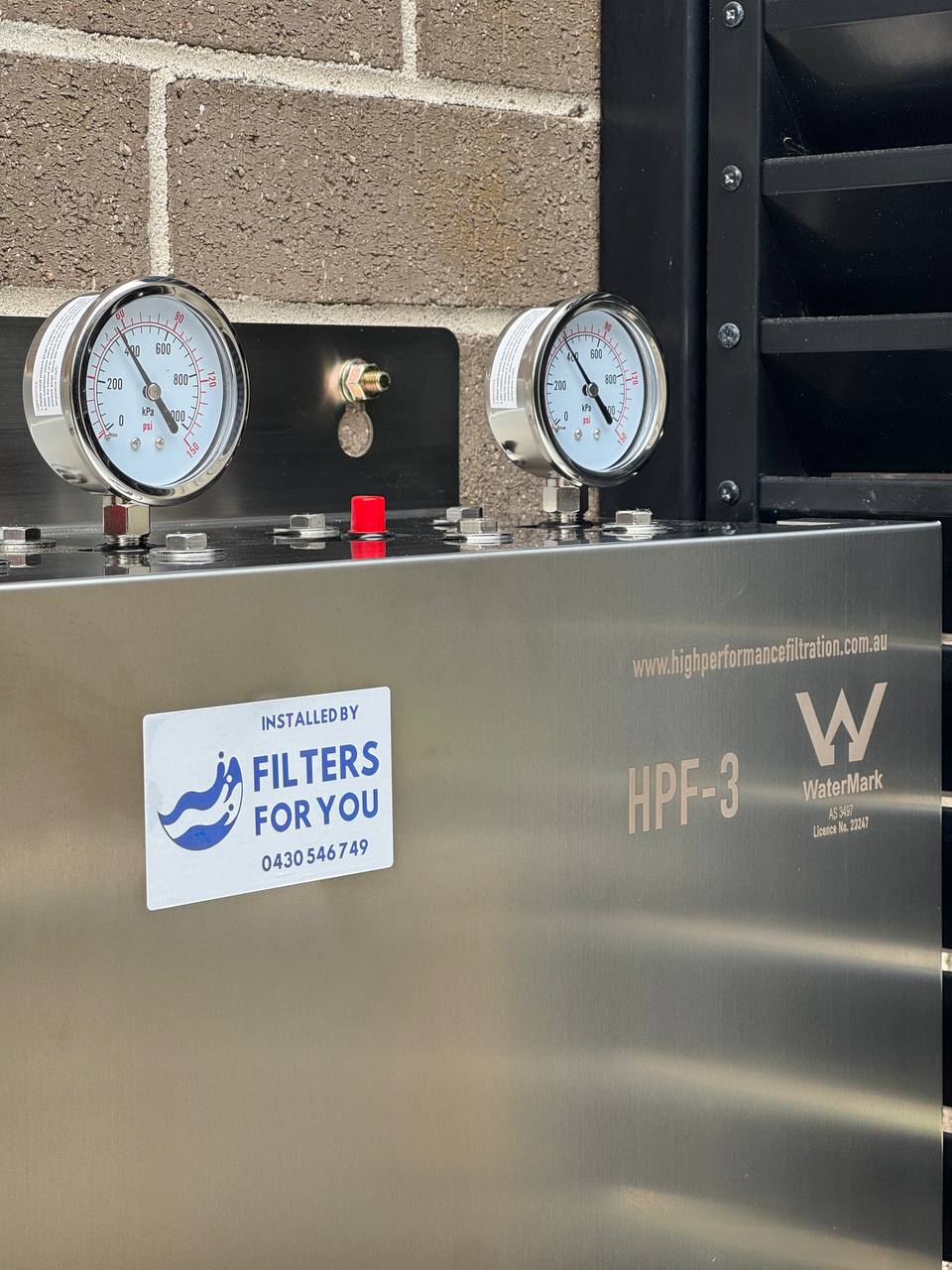
High-rise apartments in Sydney — buildings with 10 or more stories — occasionally have higher water pressure than lower-level buildings, particularly on lower floors. Higher water pressure is actually beneficial for RO system performance, improving filtration flow rate and reducing the time the tank takes to refill. For under-sink carbon block filters, pressure plays a smaller role in performance, but moderately higher pressure is not a concern for either system type.
Very high floors — above level 20 in most buildings — may have pressure reduction valves installed at the riser to protect plumbing throughout the building, which can reduce pressure to normal or even slightly below normal levels. Jean-Paul is familiar with this and can advise if your apartment's measured pressure will affect system selection or performance.
High-rise buildings also have contractor access protocols — sign-in requirements, service lift access, and occasionally a requirement for public liability insurance confirmation. Jean-Paul carries all required documentation and is experienced with Sydney high-rise building access. Call 0430 546 749 to discuss your specific building if you have concerns about access.
Water Quality in Popular Sydney Apartment Areas
Different parts of Sydney have different water quality characteristics that are particularly relevant for apartment residents:
- Inner West (Newtown, Marrickville, Leichhardt, Annandale): Supplied from Prospect reservoir via aging distribution infrastructure in some areas. Chloramine levels can be higher in areas with longer network travel times from the treatment plant. Under-sink carbon filtration significantly improves taste and removes chloramine taste and odour.
- Eastern Suburbs (Bondi, Randwick, Coogee, Surry Hills): Older pipe infrastructure in some precincts can contribute to elevated sediment and occasional taste variation. A good under-sink filter removes sediment and improves clarity and taste.
- CBD Fringe (Pyrmont, Ultimo, Waterloo, Alexandria): Heavily developed areas with new high-density building stock and newer internal plumbing. Water quality is generally good from the mains, though chloramine taste is common — under-sink carbon filtration removes this effectively.
- North Shore (Crows Nest, St Leonards, Chatswood, Lane Cove): North Shore water supply uses older cast-iron and copper distribution infrastructure in places, which can contribute to metallic taste and sediment. Both under-sink filters and RO systems address this.
What to Ask Your Strata Before Calling Jean-Paul
For most Sydney apartments, no strata enquiry is needed before booking. But if you want to be thorough, Jean-Paul suggests asking your strata manager one simple question: does the building have any by-laws relating to minor kitchen modifications that involve connection to the internal cold water supply line under the sink? In the vast majority of cases the answer is no, there is no relevant by-law, and you can proceed. If there is a specific by-law, it will typically require you to use a licensed plumber (Jean-Paul qualifies) and may require you to notify the owners corporation in writing — which Jean-Paul can assist with documentation for.
What Your Apartment Looks Like When Jean-Paul Is Done
Jean-Paul takes pride in leaving every apartment installation looking immaculate. He covers the under-sink cabinet floor with protective material before work begins, uses clean fittings and professionally dressed line runs, and ensures all connections are neat and secure inside the cabinet. He leaves no packaging, no off-cuts of tubing, and no residual plumber's tape or debris. The only trace of the installation is the filtered water tap on your bench and the system neatly housed inside your cabinet — both of which should look like they were always there.
Before leaving, Jean-Paul runs the system through its initial flush cycle, confirms the filtered tap is working correctly, and walks you through full operation. He explains the filter replacement schedule, shows you where the filter housings are located, and answers every question you have. He leaves his number and is available if any question arises after installation.